


![The Best Tool for Collaborative Research in Content Marketing Teams [2026]](/content/images/size/w2000/format/webp/2025/12/image--5-.png)
If you ask content marketers where research breaks down, very few will say they need another tool.
They’ll say things like:
- We have tons of links, but no one remembers why they were saved.
- Our research is everywhere - Slack, Google Docs, Notion, Sheets.
- Every time we work on a bigger piece, we’re almost starting from scratch.
- We have research, but we don’t have shared understanding.
The problem isn’t that content teams don’t do research. The problem is that research doesn’t stay connected, explained, or shared.
That’s because most tools help you store information. Very few help teams think together before writing starts.
And that’s where collaborative research in content marketing usually breaks down.
Why Content Research Breaks in Most Teams
Once research starts piling up, small organizational cracks turn into real workflow problems.
Links get dropped into Slack channels. Comments live in Google Docs. Insights get copied into spreadsheets - often taken from LinkedIn posts, articles, or threads someone bookmarked for later.
PDFs and reports make it even harder.
Key insights are buried deep inside long documents. People copy quotes into spreadsheets or notes, without page numbers, context, or a clear link back to the source.
At first, it feels organized. But a week later:
- no one remembers where the insight came from
- the original post is hard to find (or gone)
- you ask yourself: why was this worth saving?
By the time writing starts:
- context is missing
- decisions aren’t documented
- no one knows which insight mattered or why
So teams compensate by:
- re-reading the same sources
- re-searching LinkedIn to find the original post
- reopening long PDF reports to hunt for one quote
- re-explaining the same ideas
- re-debating decisions that were already made
And research process turns into friction instead of leverage.
The Deeper Problem: Research Has No Single Source of Truth
All of this points to a deeper issue: research exists, but nowhere it fully comes together.
Most teams collect plenty of insights. What’s missing is a single place where those insights live with their context, accessible to everyone who needs them.
Research gets distributed across:
- documents and slide decks
- Slack threads and emails
- personal notes and ad-hoc spreadsheets
Each location holds part of the picture, but none shows the full story.
Over time, it becomes hard to answer basic questions:
- What do we already know?
- Where did this insight come from?
- Why was it considered important?
Without a shared source of truth for research, insights slowly lose their value even if they were solid to begin with.
How Poor Structure Makes Research Hard to Reuse
This is where research stops being reusable and starts resetting itself.
Everyone saves insights differently. Tags, folders, campaign names, random links - whatever works in the moment.
At scale, this breaks down.
Search becomes unreliable. The same insights get saved multiple times. Context gets separated from the source.
Teams do create syntheses, but they usually live in slide decks, long reports, or one-off strategy documents. Once the project is done, those documents rarely get reopened.
So when a new piece starts, teams don’t build on existing research. They rebuild it.
Without a structure designed for reuse, research stays locked inside individual projects instead of becoming a shared asset.
Why Research Rarely Connects to Content Planning
Even when teams manage to collect solid research, it often never makes it into actual content decisions.
Insights aren’t mapped to content themes. They don’t appear in editorial roadmaps. They aren’t revisited once writing begins.
Research exists next to content planning, not inside it.
Under time pressure, teams rely on memory instead of documentation. Decisions get made in meetings or Slack threads, but the reasoning behind them isn’t captured anywhere.
What people remember replaces what’s written down.
That’s why research feels heavy to maintain and easy to ignore. It doesn’t actively move the work forward; it just sits in the background.
Why Collaboration Breaks Down in General-Purpose Tools
These problems become even more visible once multiple people are involved.
Most general-purpose research tools allow shared access, but they don’t define how teams should collaborate around research.
Without clear ownership:
- everyone organizes research their own way
- quality becomes inconsistent
- duplication becomes normal
Insights get saved multiple times, often with slightly different interpretations. Context lives in comments, Slack threads, or meetings - not next to the research itself.
As a result, research, product, and content teams work in parallel instead of building on each other’s work.
The same questions get researched more than once. Different stakeholders walk away with different conclusions.
For teams evaluating collaborative research tools, this is usually the breaking point.
What Collaborative Research Should Look Like for Content Teams
To work at scale, collaborative research needs to be structured, visible, and continuous.
For content teams, that means:
- insights are captured directly on the source
- context explains why something matters, not just what it says
- research is organized around topics and themes, not isolated projects
- discussions happen where the insight lives, not somewhere else
This creates a shared source of truth for research - one teams can return to and build on over time.
Instead of starting from scratch for every piece, content marketing research becomes cumulative.
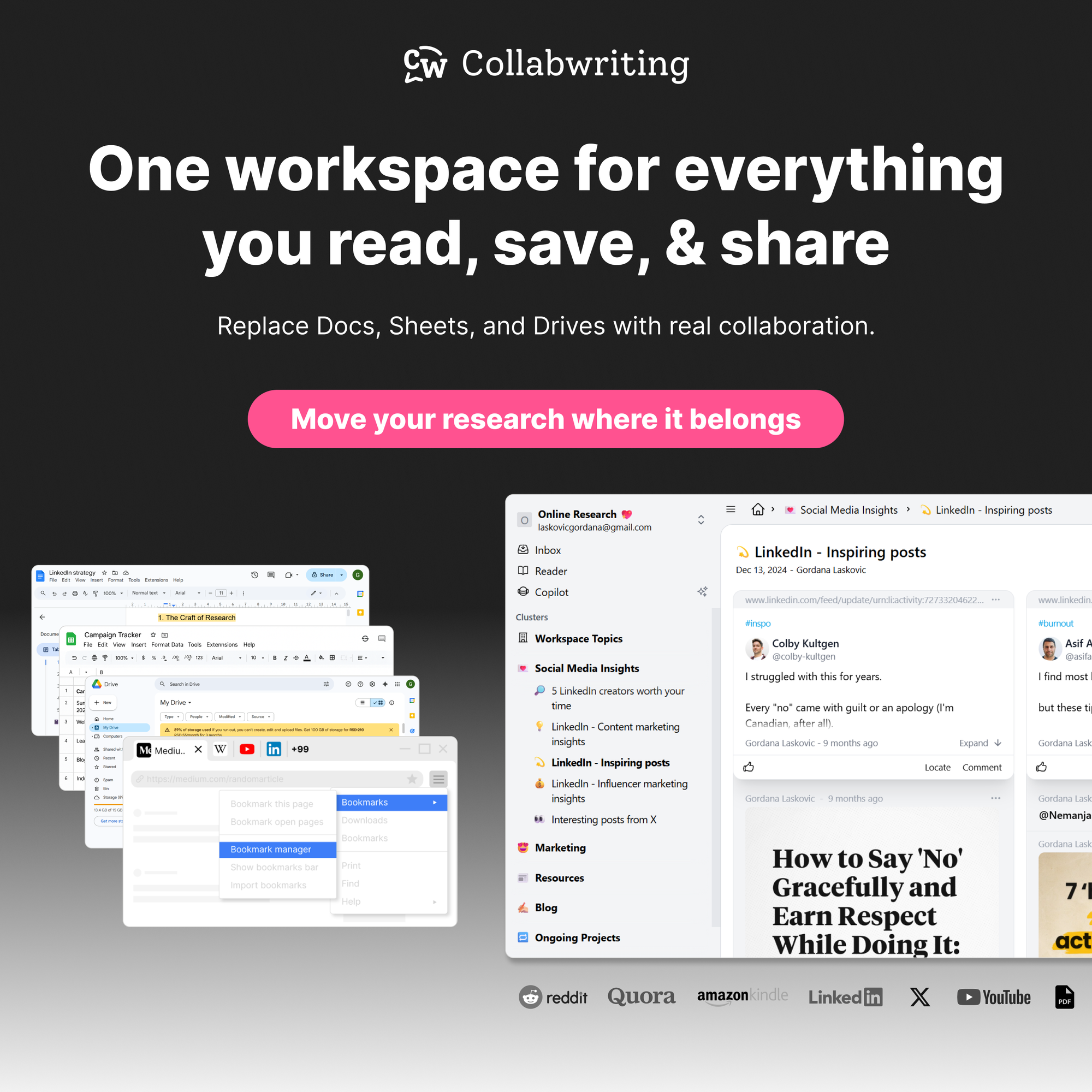
Turn scattered research into a shared library for your team
Collabwriting brings all your online sources into one shared workspace, preserving context as you research.
Highlight, save, and collaborate and turn scattered insights into unique context and outputs only your team can create.
Why Collabwriting Works for Content Marketing Teams
Collabwriting is built specifically around this collaborative research workflow.
It’s a focused research tool for content teams that need to organize insights, preserve context, and align before writing starts.
With Collabwriting:
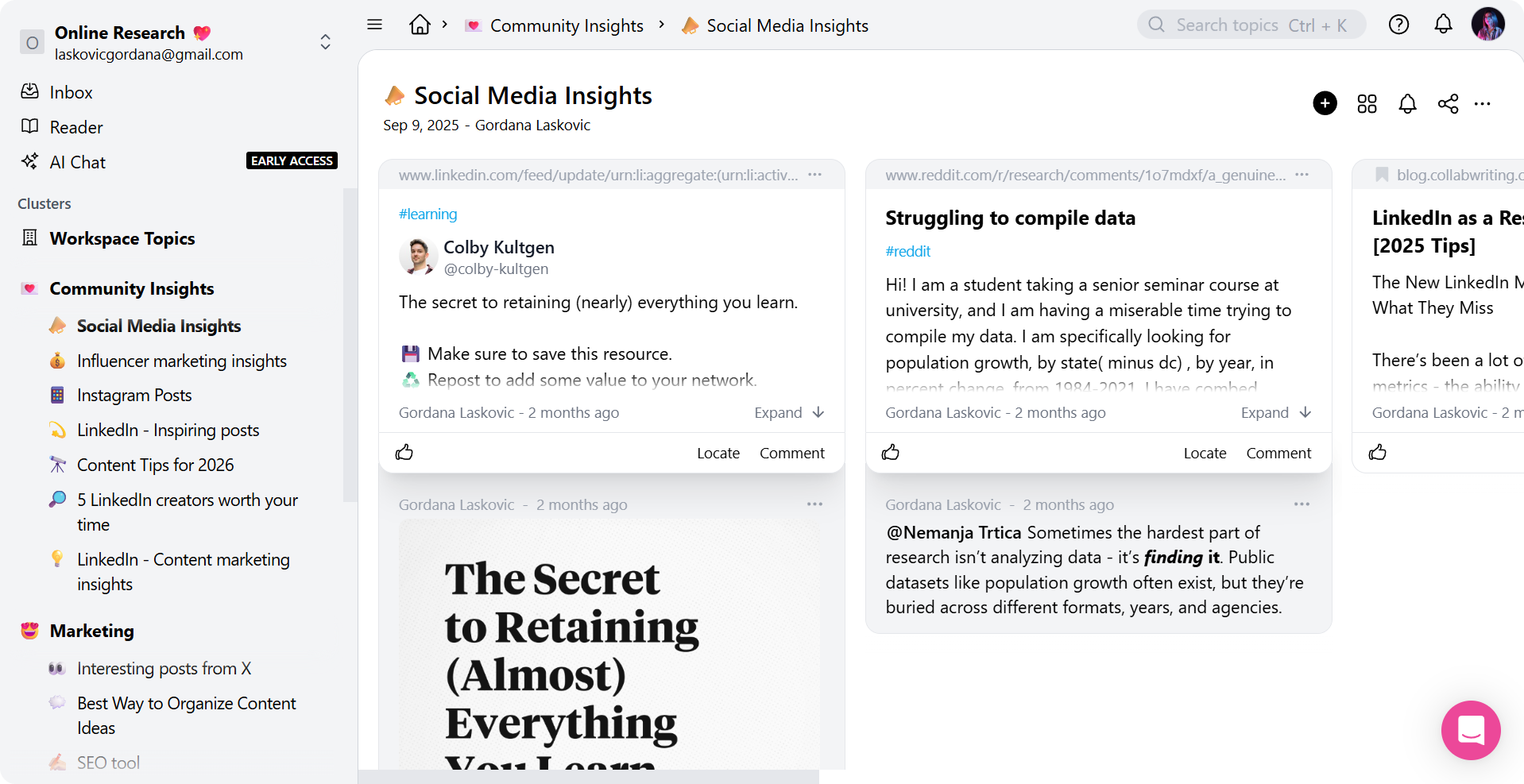
- insights are captured as highlights with comments
- context stays connected to the original source
- research is structured for reuse across multiple content pieces
- teams build shared understanding as research evolves
It doesn’t try to cover every possible use case. It focuses on one workflow and does it well.
Who This Is For (And Who It’s Not)
Collabwriting is a strong fit for teams that:
- run ongoing content marketing research
- create long-form or strategy-driven content
- need a shared source of truth for research
- want a collaborative research workflow, not just storage
So, if you’re looking for a simple bookmarking or note-taking tool, a general-purpose option may be enough.
But if your team needs a collaborative research tool designed around how content work actually happens, Collabwriting is built for that.
Final Thought
If you’re evaluating a collaborative research tool for content marketing, don’t ask how many features it has.
Ask one question instead: Can my team think together here?
With Collabwriting, the answer is yes.
FAQ
Isn't a spreadsheet or doc enough for research?
Spreadsheets and docs store information, but they don’t preserve context or show why insights matter. Over time, you lose track of sources, reasoning, and team discussions.
Collaborative research tools like Collabwriting turn scattered notes into a shared library that teams can actually build on.
How does Collabwriting handle "missing context" when team members leave or change projects?
In general-purpose tools, the "logic" behind a decision usually lives in someone’s head or a buried Slack thread. In Collabwriting, every highlight is attached to a comment and the original source. This creates a permanent digital paper trail. Even if a new writer joins a project months later, they can see exactly why a specific insight was chosen and where it came from.
How is collaborative research different from regular note-taking?
Note-taking captures what you see; collaborative research captures what matters and why. It’s structured around topics, preserves context, and allows teams to discuss insights where they live, so everyone builds a shared understanding before writing starts.
Can Collabwriting handle PDFs, LinkedIn posts, or YouTube videos?
Yes! You can clip content from almost anywhere online: web pages, PDFs, YouTube, LinkedIn, X/Twitter, Reddit, and save it with comments and context. Your team sees the insight, the source, and the reasoning in one place.
Who is Collabwriting for?
It’s ideal for teams that:
- Conduct ongoing content marketing research
- Create long-form or strategy-driven content
- Need a shared source of truth for insights
- Want a collaborative research workflow, not just storage
If your team just needs simple bookmarking or personal notes, general-purpose tools may be enough but Collabwriting shines when teams need to think together.
How do we know it’s worth switching from our current tools?
Ask one question: “Can our team think together here?” If the answer is no with your current tools, Collabwriting can help your team preserve context, align on insights, and build cumulative knowledge that actually improves content quality.


![5 Tools Marketers Use to Organize Research - Compared [2026]](/content/images/size/w600/format/webp/2025/11/cover-4-1.png)

![Build Credibility in Research: Smart Way to Verify Information and Track Sources Easily [2025]](/content/images/size/w600/format/webp/2025/10/covers-for-blog--7--1.png)

![How Marketers Can Turn LinkedIn Content into Collaborative Research [2025]](/content/images/size/w600/format/webp/2025/10/covers-for-blog--8-.png)
![Best Readwise Alternative for Personal & Team Research [2026]](/content/images/size/w600/format/webp/2025/09/Frame-814--3-.png)


